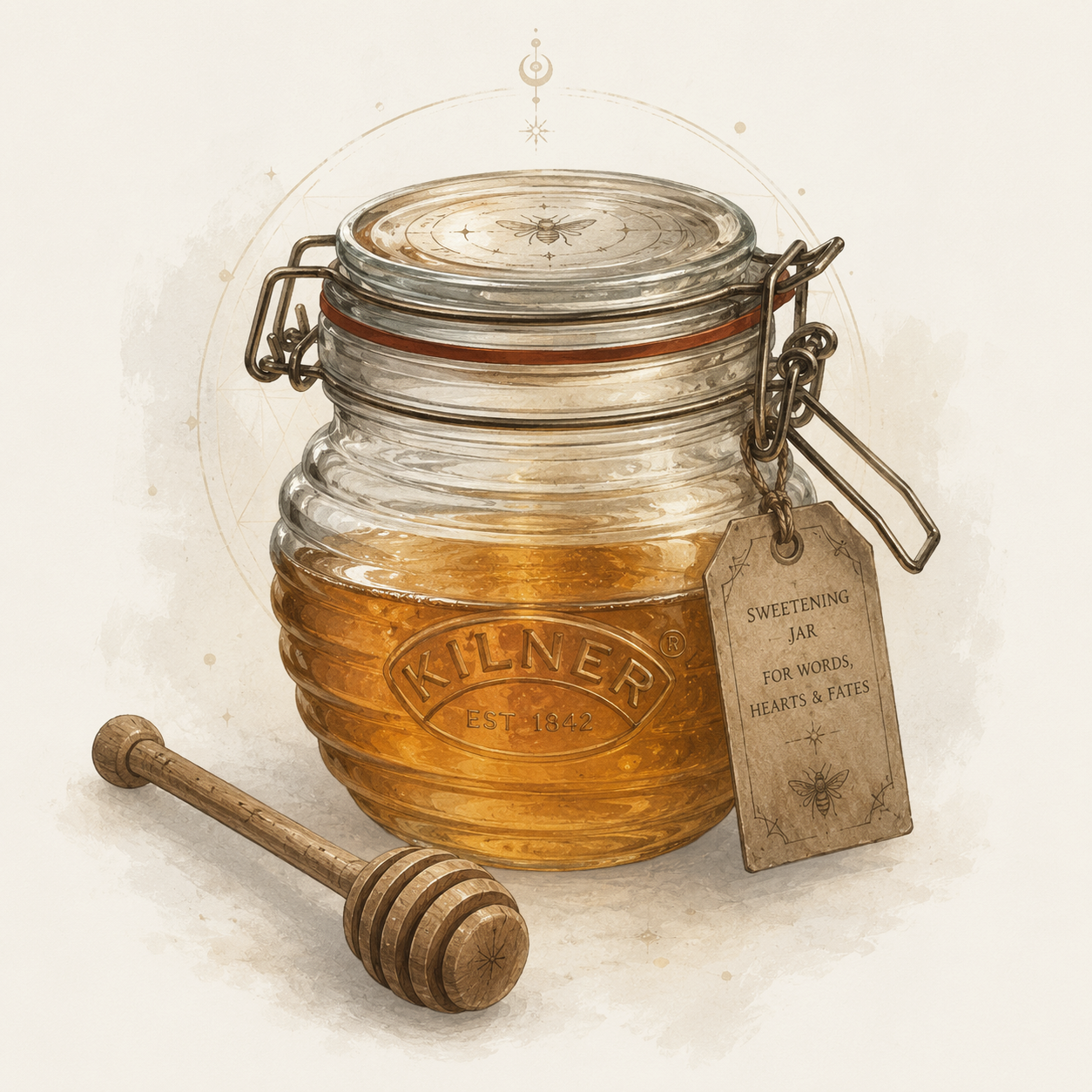
Sweetening Jars
A practical guide
There is something satisfying about the straightforward logic of sympathetic magic. Like draws like. Sweet draws sweet. You want to soften a situation, sweeten a relationship, draw favour toward you — so you work with the sweetest substance available, and you make your intention part of it.
The sweetening jar appears independently across folk magic traditions worldwide: in the kitchen witchcraft of the British Isles, in Continental European folk practice, and in Hoodoo, the African American conjure tradition shaped by African, Native American, and Caribbean roots. It is not difficult to see why it arises so consistently across cultures. The logic is self-evident, the materials are often already in your kitchen, and the working rewards both the beginner and the experienced practitioner.
Its power lies not in complexity but in clarity. You decide what you want, gather what corresponds to it, and set the work in motion.
What Is a Sweetening Jar?
A sweetening jar is a container of sweetening substance into which you place a written petition and chosen ingredients, with the intention of drawing something toward you or improving a specific situation. The sweetener is both symbolically and physically doing work: it preserves, envelops, and permeates everything inside. Your intention is literally steeped in sweetness.
These workings serve many purposes: drawing love or deepening an existing relationship, improving communication, seeking favour from a person in authority, softening a difficult dynamic at work, or bringing goodwill toward yourself in a specific situation. You can make one directed entirely at yourself — so that you will be kinder and more loving in all your dealings. You can make one to mark a marriage and bless a couple with years of tenderness. The working is not limited to romantic matters, whatever its popular reputation suggests.
One point worth stating plainly: a sweetening jar is not a tool for overriding another person’s will. Well-constructed workings of this kind operate in the realm of influence, not coercion. You are shaping conditions, not forcing outcomes.
Choosing Your Sweetener
This is the most important decision in the working, and the one most often treated as an afterthought. The sweetener is not merely the medium; it is the character of the working itself. Every other ingredient sits inside it, is permeated by it, is defined by it. Choose well, and everything else falls into place naturally. Each sweetener has a distinct nature. They are not interchangeable.
Honey
Honey is the slowest and the deepest. It has been sacred in virtually every human culture: ancient Egyptian offerings to the gods, the Hindu Panchamrita, the mead of the Celtic gods, the golden substance left at fairy mounds in Scottish Gaelic practice. In Scotland, local honey given to the sick in folk medicine was both healing and magical; the two being indistinguishable.
Its nature is preservation. Honey never truly spoils. Seal something inside it, and it will be held indefinitely. What you place in honey you are placing in something that does not let go. A honey jar is a long-term commitment, suited to workings you intend to tend over months or years: deep love, an ongoing relationship, a lasting professional bond, a sustained change in how someone perceives you.
Honey also carries a sacred weight that refined sugar does not. If the working calls for something to feel genuinely offered rather than merely constructed, honey is the right choice.
White Sugar
White sugar is fast and clear. Strip away the complexity of honey, and you have pure sweetness with no secondary notes; no earthiness, no weight. Where honey slowly permeates, sugar dissolves rapidly and completely. It is well suited to situations where you need a quick shift in attitude rather than a deep, permanent transformation.
Use white sugar when the situation is uncomplicated, when you need results sooner rather than later, or when the relationship does not require the sustained, binding depth that honey provides. It is also more practical to work with, and the petition paper can be retrieved and replaced if you need to revise your intention.
Brown Sugar
Brown sugar sits between white sugar and molasses. It has the relative speed of sugar with a warmth and earthiness that white sugar lacks. The residual molasses gives it body, depth, and a quality of domesticity that makes it specifically suited to matters of the home, the family, and relationships that are comfortable and affectionate rather than passionately romantic.
Where white sugar is clarity and clean light, brown sugar is a warm kitchen on a dark afternoon. Use it for family harmony, for sweetening long-standing relationships that need warmth rather than fire, and for domestic working of any kind.
Raw / Demerara Sugar
Raw, unrefined sugar carries the full energy of the cane before refining. It is closer to the source, closer to the earth. The coarse crystals dissolve more slowly than refined sugar, giving it a pace somewhere between white sugar and honey. Use it when the worked-over, refined version feels too removed from the living plant it came from, or when you want the natural, unmediated quality of the sweetening in the work.
Molasses / Black Treacle
Molasses is the heaviest, darkest sweetener available, and its character is unlike any of the others. Where honey preserves and holds gently, molasses grips. It is thick, reluctant to pour, and clings to everything it touches. In British kitchen tradition, black treacle goes into parkin and treacle toffee — foods associated with autumn, Bonfire Night, and Samhain — giving it a seasonal correspondence the other sweeteners lack.
The magical nature of molasses is tenacity. Use it when you need something to adhere absolutely, when you want a situation or connection to stick fast and resist slippage. This is not honey’s patient, enduring sweetness. It is a grip. Use it with clear intention; the same tenacity that holds what you want makes a working harder to dismantle if you later need to.
Maple Syrup
Maple syrup is the sweetener of abundance, warmth, longevity, and authority. It comes from the forest rather than the field or the hive, and a maple tree takes years to produce enough sap to harvest. That patience and duration are part of its magical character: maple syrup is associated not just with prosperity but with things that last, situations that deepen over time, relationships that improve with age. Use it when you want not just a result but an enduring one; a career that builds, a financial situation that stabilises and grows.
It is also well suited to softening those in positions of power. There is a generosity and authority to maple syrup that neither sugar nor molasses carries.
Jam and Preserves
Jam occupies a special place in kitchen witchcraft beyond its sweetness. Making jam is itself one of the most powerful acts of kitchen magic: taking the fruit of the living season, transforming it through heat and sugar, sealing it in a jar, preserving that energy through the dark months. Every jar of jam on a Scottish pantry shelf is a small working of that kind, whether consciously made so or not.
Using jam brings the energy of that process with it — preservation, transformation, the memory of summer held through winter. It is particularly suited to domestic working: sweetening the hearth, preserving something that matters, holding warmth in a house through difficult times. Raspberry jam carries its own Gaelic sweetness; elder carries protection, and the Otherworld; rowan jelly carries specifically Scottish warding energy alongside its tartness.
Agave
Agave is not simply a vegan substitute for honey. The agave plant is desert-born, drought-resistant, and intensely concentrated, and those qualities carry into the working. Where honey is patient and preserving, agave burns cleaner and hotter. It is suited to workings where you want to kindle or rekindle desire — passion specifically, rather than the slow deepening of an existing bond. It is also the closest match to honey in terms of viscosity and binding quality, making it a practical choice when honey is not appropriate to your practice.
Simple Syrup
Simple syrup — equal parts sugar and water, dissolved — is the most flexible option when nothing else suits. It fills and coats herbs efficiently, and can be made in minutes from what is already in the kitchen. Folk magic has always been adaptable. The clarity of your intention matters more than achieving a particular ingredient. Simple syrup says: I am working with what I have, and I am working deliberately. That is enough.
Take time with this choice before you reach for anything else. The sweetener tells you what kind of working you are actually doing — and that clarity, before a single herb has been added, is where the real work begins.
What You Need
Gather everything before you begin. Interrupting a working to search for a missing ingredient breaks the current.
- The jar: a small glass jar with a tight-fitting metal lid. The metal lid matters if you intend to burn candles on top.
- Your sweetener: chosen deliberately from the section above. This is the most important decision. Make it before anything else.
- Petition paper: a slip of brown paper, torn rather than cut. A pen with good, permanent ink.
- Your herbs and other ingredients: chosen to your specific intention. A few well-chosen things are more powerful than a jar stuffed with everything that sounds vaguely relevant.
- A candle (optional but traditional): pink for love and self-love; red for passion; white for peace or general working; green for financial sweetening; yellow or gold for success and career; blue for communication; purple for spiritual or authority matters. A taper or chime candle burns down in one session, which is ideal.
- Anointing oil (optional): for dressing the candle and the petition paper, appropriate to your intention.
That is the whole of it. Everything else is elaboration.
The Petition Paper
The petition paper is the heart of the working. Write on a piece of brown paper torn rather than cut — the torn edge is considered more raw and natural than a scissored line.
Choose your ink with intention:
- Blue for communication and emotional matters
- Black for strength and permanence
- Green for financial or prosperity workings
- Red for love and desire
Write your target’s name three times, one below the other. Rotate the paper 90 degrees and write your own name three times directly over theirs, crossing and covering their name completely. For a self-sweetening jar, write only your own name twice — you are both target and practitioner at once.
Write your intention in a continuous circle around the names without lifting your pen from the paper. Keep it short enough to complete in one unbroken circuit — something like bring us closer together and fill our relationship with warmth and ease, written in running script so the circle closes. Phrase it in the present tense: not I hope they consider me, but I am seen, valued, and chosen. The magical field responds to the statement of what is, not the wish for what might be.
Decorate the petition if you are moved to — symbols, a dried flower, a dab of colour. Anoint it lightly with an appropriate oil. Then fold the paper toward you, rotate 90 degrees, fold toward you again, rotate once more and fold a third time. Three folds, always drawing toward the body, each fold concentrating your desire into the paper. It is ready.
Your Signature
A personal concern anchors the working to you specifically. Your handwriting already carries your energy. Beyond that, practitioners may add a hair, a drop of saliva, or, in more serious workings, a drop of blood. For workings directed at another person, their hair or a photograph creates a strong link. If no personal concern of the target can be obtained, writing their name on a piece of ginseng root is a traditional substitute.
Herbs, Roots, and Botanicals
Each ingredient you add corresponds to a specific intention, quality, or influence. Add each one at a time and name its purpose as you do so, aloud or inwardly. You are making conscious, deliberate choices; not filling a jar at random.
For Love and Romance
Rose petals are the most universally resonant botanical for matters of the heart. Red for passionate love and desire; pink for affectionate, nurturing love; white for spiritual love and purity of intention.
Jasmine draws strongly through its intense sweetness. Associated with the Moon and nocturnal magic, prophetic dreaming, and spiritual openness alongside attraction. Use it sparingly.
Cardamom is warming and intoxicating in scent, specifically associated with lust, fidelity, and the deepening of physical and emotional bonds.
Damiana is direct and unambiguous; specifically for romantic and erotic workings.
Honeysuckle sweetens a person’s thoughts and draws romantic warmth. Traditional for sweetening the way others think of you.
Adam and Eve Root is a folk-magic curio: two roots placed together to symbolise union, used to draw two people together and keep them bonded.
For Peace, Harmony, and Communication
Lavender calms aggression, prevents arguments, and builds trust. Excellent wherever a difficult dynamic needs to soften — workplaces, family situations, anywhere friction has accumulated.
Chamomile is patient and quietly effective. It promotes relaxation and emotional healing, and is traditionally used when seeking favour from those in authority.
Lemon balm heals broken ties and brings joy back to a situation. The Greek nymph Melissa, associated with honey bees, is connected to this herb; making it a natural ally in honey jar workings. It also attracts bees, linking it further to honey magic.
Catnip draws good fortune, joy, and lightness. It brightens the atmosphere of the working.
Spearmint or peppermint freshens and clears. Use when lines of communication have gone silent, or when you want your words to arrive with clarity.
For Success, Luck, and Abundance
Cinnamon is one of the most powerful and versatile additions available. It speeds workings, heats intention, and is associated with luck, success, money, and love.
Cloves hold what has been drawn. They prevent interference and add permanence. Associated with luck, respect, and binding what you have gained so it is not lost.
Ginger root amplifies and accelerates; like cinnamon, it heats and quickens. It also carries confidence, power, and the energy of asserting your worth.
Orange peel brings brightness and draws good things: money, love, happiness, positive attention. Corresponds to solar energies.
Bay laurel is sacred to Apollo and associated with achievement, recognition, and the crowning of success.
Calendula is particularly useful in legal matters, negotiations, or any situation where you need the outcome to fall in your favour.
High John the Conqueror root is used specifically for victory in adversarial situations — legal matters, court cases, confrontations with authority, workings where the odds feel stacked against you. Use a small piece in legal or authority-related jars.
Basil symbolises prosperity, luck, protection, and good business fortune.
For Comfort and the Home
Vanilla draws people toward warmth and ease. One of the simplest sweetening workings: place a whole vanilla bean in the household sugar canister. The sugar used in daily cooking then carries the energy of peace and happiness into the home.
Orris root is a traditional love-drawing root. A fixative, it develops slowly and holds its energy — suited to patient, long-term work.
Rosemary is protective as well as sweetening. It strengthens memory and loyalty, and ensures nothing negative enters the working.
Crystals
Small tumbled crystals add their own resonance. Take care with some crystals here (e.g. pyrite); they should not get wet and should be placed with the jar, not in the fluid.
- Rose quartz for love and self-worth
- Rhodonite for empathy, emotional healing, and forgiveness; it works alongside rose quartz but with a more active, clearing quality
- Garnet for passion, physical desire, and the deepening of intimate bonds
- Clear quartz to amplify the whole working
- Citrine for abundance, success, and joy (natural citrine is pale golden-yellow and self-cleansing; it needs no moonlight recharging)
- Green aventurine for luck and opportunity
- Pyrite for professional confidence and command of respect
- Tiger’s eye for personal power and steady courage in career or legal situations
- Smoky quartz for protection and grounding
- Amethyst for calm, clarity, and self-healing.
Always confirm a crystal is safe to submerge before adding it. Most common tumbled crystals are fine, but it is worth checking.
Four Common Scenarios
Each situation calls for a different approach. Here is how to tune the working to four of the most common intentions.
A Romantic Partner
To draw back affection, soften arguments, deepen intimacy, or build a new connection.
- Sweetener: Honey for deep, lasting bonding; molasses if you need the love to hold fast and not slip away
- Candle: Pink for romance and emotional healing; red for passion and physical desire
- Herbs: Rose petals, jasmine, cinnamon
- Crystals: Rose quartz, rhodonite, garnet
- Petition circle: Love me deeply, treat me gently
A Difficult Colleague or Boss
To improve a toxic working environment, secure recognition or promotion, or shift a stubborn supervisor’s perception of you. The goal is genuine professional respect and goodwill, not domination.
- Sweetener: White sugar for fast results before a review or confrontation; maple syrup for steady, sustained improvement over time
- Candle: Blue for peaceful communication and reducing tension; yellow for visibility and professional success
- Herbs: Mint or basil for prosperity and favour; chamomile to calm anger and soften resistance
- Crystals: Pyrite for professional confidence; tiger’s eye for personal power and clarity of purpose
- Petition circle: Appreciate my work, grant me favour
A Legal Matter
To sweeten a judge, jury, solicitor, or institution; drawing a favourable ruling, reducing a penalty, or moving bureaucratic processes in your direction. Legal jars require patience; use sweeteners that work slowly and endure.
- Sweetener: Honey or maple syrup, both suited to institutional matters requiring lasting outcomes
- Candle: Green for financial resolution or legal favour; brown for justice, stability, and court victories
- Herbs: Bay laurel for success; chamomile for favour from authority; calendula for legal outcomes turning in your favour; High John the Conqueror root for victory in adversarial situations
- Crystals: Clear quartz to amplify; tiger’s eye for strength and steady resolve
- Petition circle: Write the full name of the person whose favour you seek, overlapped with your own name. Circle with: Rule in my favour, grant me justice.
Self-Love
Directed entirely inward — to quiet the inner critic, heal from old wounds, build self-worth, and cultivate genuine kindness toward yourself. Write your own name both times; target and practitioner are the same person.
- Sweetener: Honey or agave; both nurturing and gentle rather than fierce
- Candle: White for peace and purification; pink for self-acceptance and emotional healing
- Herbs: Lavender for peace and calm; rosemary for mental clarity and self-remembrance; calendula for warmth and joy
- Crystals: Rhodonite for compassion toward yourself; amethyst for clarity and the stilling of anxious thought
- Petition circle: Write your own name three times, rotate, write it three times again over the first set. Circle with: I am worthy. I am gentle with myself.
Candle Colour
The candle burned on top of the jar brings fire into the working and provides a focal point for intention. In traditional practice, it is burned directly on the metal lid.
Choose the colour to match your intention:
- pink for affectionate love-related working
- red for passionate desire
- white as a universal substitute, and for clarity and self-working
- yellow or gold for success, career, and professional favour
- green for abundance, money, and financial sweetening
- blue for communication and calm; brown for justice, stability, and court victories
- purple for spiritual matters or authority.
Dress the candle with oil, drawing from the base toward your body for drawing work. You can also dress it with ground herbs, and if you are so inclined, a little glitter.
Friday is the traditional day for love-related sweetening work; Sunday for success and recognition; Wednesday for communication. These are guides, not rules.
Assembling the Jar
Ground yourself before you begin. Approach the working from a place of confident expectation rather than anxiety — the energy you bring infuses what you make.
Place the folded petition paper into the jar first, then add your botanicals and other ingredients one by one, naming each as you go. Pour your sweetener over everything until the contents are covered, and the jar is full or nearly so. As you pour, visualise the relationship or situation becoming warm and smooth. Before sealing, observe one traditional step: taste a small amount of the sweetener directly from the jar. As you do, say aloud — as this honey is sweet to me, so shall [name] be sweet to me — or whatever words fit your working. It is a direct, embodied act of sympathetic magic, rooting the working in the body as well as the mind. Then seal the lid firmly.
Hold the jar in both hands and speak your intention to it clearly. State what you want. Breathe into it.
If you are burning a candle, light it now and let it burn on top of the lid. When it has burned down, allow the wax to drip over and around the sealed lid, sealing and locking the working in. Let the wax set before moving the jar.
Working the Jar
A sweetening jar benefits from regular attention. This is how you keep the energy active.
Daily: Shake the jar while stating your intention aloud. Keep it short and direct; the same phrase you wrote in the circle on your petition, spoken with conviction. This is called feeding the jar. You are not simply reminding yourself of what you want; you are actively pushing energy into the working.
Weekly: Burn a fresh candle on top of the jar. As it burns, give your full attention to the intention and visualise the outcome as already real. Let the wax drip down and add to the seal. Between candle sessions, you can hold the jar and focus on warm, positive thoughts about the situation; this feeds the working too.
Anoint the outside of the jar with a complementary oil if you wish. Keep it in a private place where it will not be disturbed or handled by others.
Signs the Working Is Taking Effect
In the jar: the candle burns with a strong, steady flame; the wax melts evenly down the sides of the lid; the sweetener settles and flows smoothly. These are good signs; the energy is moving without obstruction.
In the situation: the person begins reaching out more often, or the tension in your interactions softens and gives way to warmth. They may mention you to mutual friends unprompted, act with unexpected kindness, or show small signs of thawing. You may experience vivid dreams about the person; this often indicates that your energy is actively connecting with theirs, and is worth noting rather than dismissing.
Trust incremental shifts. A sweetening jar works the way honey moves; slowly, thoroughly, and in every direction at once.
Signs the Working Needs Attention
If you are using honey and it crystallises in the jar, take notice. Solid honey can reflect a block in the working’s progress. Feed it: burn a candle, shake it daily, speak your intention clearly and consistently.
If things appear to get worse before they get better, do not immediately assume failure. Sometimes a sweetening working brings buried tension to the surface before it can be resolved. Hold steady, keep feeding the jar, and give it time.
If there is no movement after sustained, consistent work, return to the petition. Was the intention truly clear? Was the sweetener the right choice? Is there ambivalence or unresolved anger in you that is working against the jar’s direction? Sometimes a stalled working tells you something about yourself rather than the situation, and that is information worth having.
When the Working Is Done
Once your intention has manifested, you have choices. Dismantle the jar with gratitude and release the contents outside or into a moving body of water, provided you used only edible ingredients. Wash the jar; it can be reused. Some practitioners keep jars running indefinitely for ongoing relationships or situations they want to maintain.
If you dismantle a working that never gained traction, do so without self-recrimination. Sit with what you have learned, and begin again with greater clarity when you are ready.
The sweetening jar asks for specificity, intentionality, and patience. It rewards the practitioner who chooses ingredients with care, writes a petition with conviction, and tends the work once it is underway. It is also, in the best possible sense, a practical work rooted in the material world, in actual things you can smell, touch, and hold. That groundedness is part of its power. You are not wishing vaguely into the dark. You are building something.
Begin with clarity. Tend with care. Trust the sweet, slow work of it.